
Blog
How to Verify EV Wheel Fitment Before You Order

Quick answer: A matching diameter and bolt pattern do not prove that a wheel fits an EV. Before ordering, verify the exact year, make, model, trim and brake package; wheel diameter and width; bolt pattern; center bore; offset; brake and suspension clearance; wheel and tire load capacity; and the required mounting hardware. If any one of those fields is missing or conflicts with the vehicle manual or a tested fitment record, stop and confirm it.
Why wheel diameter and bolt pattern are not enough
“It is an 18-inch, five-lug wheel” describes only part of the interface. Multiple bolt-circle diameters can use five fasteners, and two wheels with the same nominal diameter can differ in width, offset, center bore, spoke shape, barrel clearance, load rating, seat profile, and fastener size. A listing that matches only “18 inch” or “5 lug” is therefore not a verified fitment.
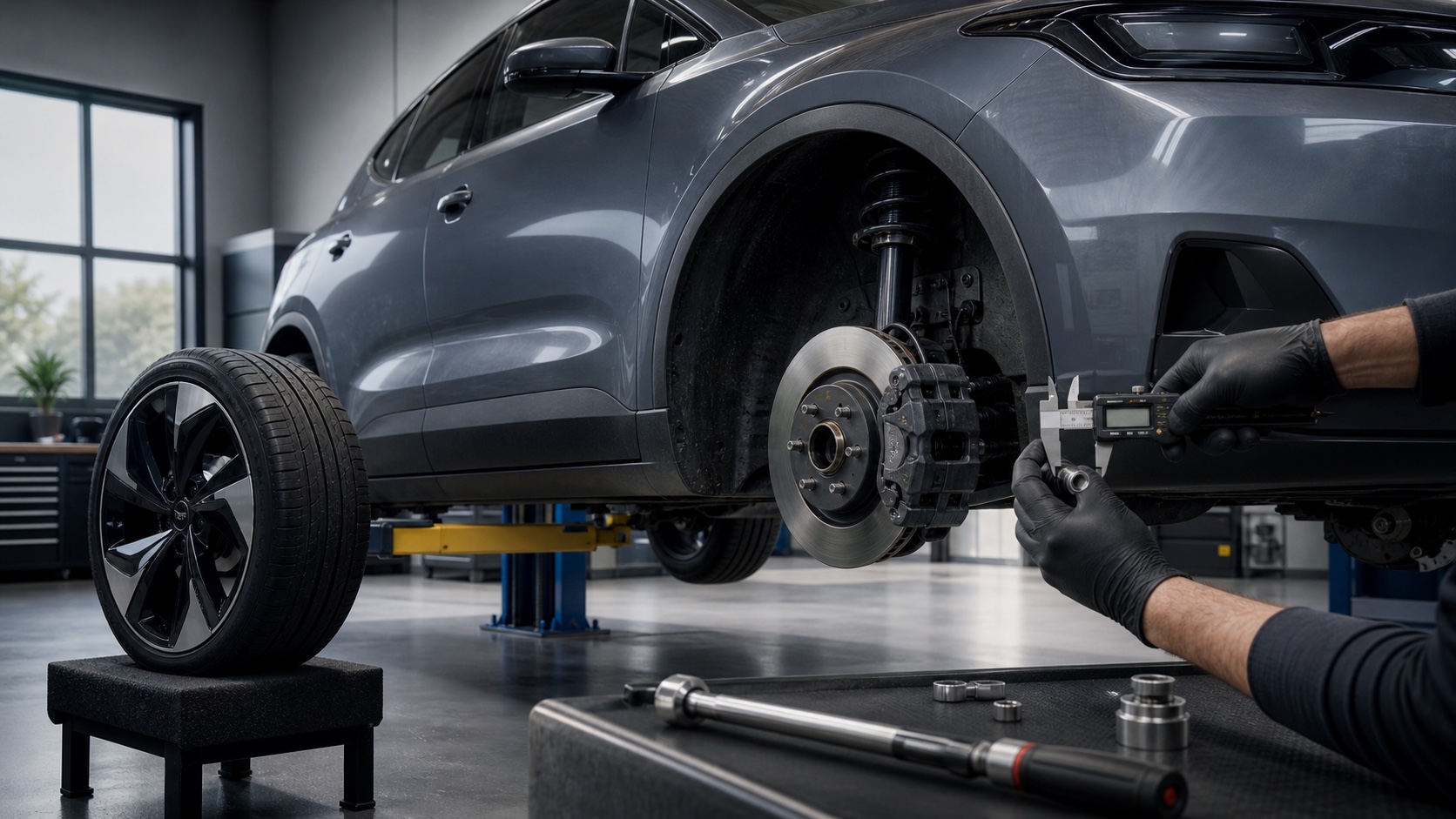
Even a complete-looking numeric match needs a vehicle-level check. Brake packages can vary by trim or build date. A wheel may clear the hub and studs yet touch a caliper because of its spoke contour. A tire may mount on the wheel but contact a suspension component or body liner at steering lock or suspension compression. Tire Rack’s documented fitment process checks the vehicle and wheel as a system, including brake shape and suspension clearance, rather than relying on size alone.
Eight checks before you order
Use the vehicle owner’s manual, tire-information placard, exact wheel manufacturer documentation, and a model-specific tested-fitment record. Do not transfer a result from a similar-looking vehicle or another model year without confirmation.
| Check | What to match | Why it matters | Do not accept |
|---|---|---|---|
| 1. Exact vehicle | Year, make, model, trim, drivetrain, wheel position, brake package and relevant build date | Factory brakes, hubs and axle loads can change within one nameplate | “Fits most,” make-only categories, or a neighboring model |
| 2. Diameter and width | Wheel bead-seat diameter and width, plus an approved tire size | Controls tire compatibility, brake-barrel room and inner/outer clearance | A diameter-only match or a tire stretched outside approved rim width |
| 3. Bolt pattern | Fastener count and pitch-circle diameter, such as 5×114.3 | The wheel holes must align exactly with the hub hardware | “Five lug” without the circle measurement |
| 4. Center bore | Wheel bore versus vehicle hub diameter; specified centering ring if permitted | An undersized bore will not seat; an application may require the correct centering solution | Grinding the bore or improvising a spacer/ring |
| 5. Offset | Approved offset range for the exact wheel width and vehicle | Changes inner suspension room, outer fender position and steering geometry | “Flush fit” as a substitute for a measured value |
| 6. Physical clearance | Caliper, spoke, barrel, hub-height, suspension, liner and body clearance through operating range | A dimensional match can still interfere under steering or suspension movement | A static visual guess or a fitment from another brake package |
| 7. Load capacity | Wheel rating and tire load index against the vehicle’s axle requirements | The assembly must support the loaded vehicle, not only its curb weight | An unmarked wheel, unknown rating, or lower tire load index |
| 8. Hardware and systems | Nut/bolt thread, seat type, shank length, torque, TPMS compatibility and any approved ring | Wrong seats or engagement can prevent correct clamping; TPMS compatibility affects monitoring | Reusing original hardware unless the wheel instructions explicitly allow it |
Offset must be read together with width
Offset is the distance between a wheel’s mounting face and its centerline, normally stated in millimetres. It cannot be judged safely in isolation: changing wheel width while keeping the same offset changes both the inner and outer position. A low offset that looks visually aggressive can reduce fender clearance; a high offset can move the wheel toward suspension or brake components. Use the exact wheel width and a tested vehicle-specific range.
Center bore and fastener seat are separate checks
The center bore describes the opening that fits over the vehicle hub. Fastener seat describes the contact shape between the nut or bolt and the wheel—often conical, ball/radius, flat or a wheel-specific design. A wheel can have the correct center bore and still use incompatible hardware. Confirm the hardware part number or every relevant dimension from the wheel maker.
Load capacity needs a number
NHTSA-hosted wheel guidance says not to use a wheel when its load rating is unavailable and describes a common minimum check of the vehicle’s heaviest gross axle weight rating divided by two. That is a safety floor, not a complete fitment approval. Follow the vehicle and wheel manufacturers’ requirements, including any derating or use restrictions.
What changes for an EV?
The geometric checks are the same as for any vehicle, but EV weight, torque delivery and efficiency make weak assumptions more costly. Michelin’s EV guidance directs owners to start with the door-jamb specification and to retain the required tire size, load index, speed rating, and XL or HL designation. A tire’s marketing label does not replace those fields.
Wheel mass and aerodynamics can also affect ride, acceleration, consumption and range. A visually similar wheel is not guaranteed to duplicate the efficiency or brake cooling of the original equipment design. Treat a range estimate as vehicle- and setup-specific; do not promise a fixed gain or loss from diameter alone.
Some EVs use staggered wheel or tire sizes, meaning the front and rear specifications differ. Tesla’s Model 3 manual, for example, lists certain factory 20-inch configurations with different front and rear widths and offsets. That example is a reminder to verify each axle, not a specification for another year, trim, market or model.
Build a five-minute fitment evidence pack
Collect the following before contacting a retailer or installer. Clear evidence makes a useful yes/no answer possible and prevents a category label from being mistaken for fitment proof.
- Vehicle identity: model year, make, model, trim, drivetrain, market, and whether brakes or suspension are factory or modified.
- Door-jamb label: a readable photo of tire size, pressure and load information. Do not send the VIN publicly.
- Current setup: the complete tire sidewall size and the wheel size/offset markings if accessible.
- Candidate wheel: manufacturer, exact part number, diameter, width, bolt pattern, center bore, offset and published load rating.
- Hardware: required nut or bolt thread, seat type, torque instruction, centering-ring part number and TPMS notes.
- Changes: lift/lowering amount, spacers, brake conversion, body changes or anything else that alters clearance.
A screenshot of a marketplace title is not enough. Prefer a manufacturer application guide, a current technical drawing, or a retailer record backed by measured/tested fitment. If sources disagree, hold the order until the exact vehicle and part number are reconciled.
Installation and first-drive checks
Have a qualified installer inspect the hub face, mounting hardware, tire direction, valve/TPMS equipment and physical clearances. Use the torque value and sequence specified for the vehicle and wheel combination; do not copy a torque number from another EV. Tesla’s own manuals illustrate why model documentation matters by publishing wheel-specific factory dimensions and a stated lug torque for each applicable vehicle.
Before normal driving, confirm that every wheel seats flush and rotates without contact. Check clearance at steering lock and where the installer can safely inspect suspension travel. Verify cold tire pressure against the vehicle label. After the installation interval specified by the wheel or hardware maker, complete any required torque recheck. Stop promptly for vibration, rubbing, steering pull, warning lights, a loose-fastener indication or pressure loss.
Do not order or install when:
- the listing names only a make, a broad model family or “universal” fit;
- the exact part number, offset, center bore or wheel load rating is unavailable;
- the fitment source covers a different model year, trim, axle or brake package;
- a spacer, adapter, bore modification or different hardware is proposed without manufacturer approval;
- the tire load index or XL/HL designation is below the vehicle requirement; or
- two authoritative sources conflict and no tested-fitment record resolves them.
EV wheel fitment FAQ
Does the same bolt pattern mean a wheel fits?
No. It leaves center bore, width, offset, brake and suspension clearance, load rating, hardware, tire compatibility and exact vehicle application unresolved.
Can a hub-centric ring make any larger-bore wheel fit?
No. A ring addresses centering only when that solution is approved for the specific wheel and vehicle. It does not correct bolt pattern, offset, clearance, load capacity or fastener-seat incompatibility.
Do EVs always need special wheels?
They need wheels that meet the exact vehicle’s geometry, load and installation requirements. “EV” branding by itself proves none of those. A non-EV-branded wheel may be suitable when its manufacturer approves the exact application and all specifications match.
Is a higher tire load index always acceptable?
Load capacity is only one field. The replacement must also have an approved size, construction and speed rating and must comply with the vehicle and tire manufacturers’ guidance. Ask a qualified installer when changing from the original specification.
Need an exact-part fitment check?
Send the vehicle year, make, model, trim and brake package plus the wheel manufacturer and exact part number through the Parts4EVs contact page. Include the numeric wheel specifications; leave private identifiers such as a full VIN out of public messages.
You can also browse the current Parts4EVs catalog. A category path is a discovery aid, not final fitment proof.
Technical sources
- NHTSA TireWise — tire placard, pressure, load and replacement-tire safety guidance.
- NHTSA-hosted Wheel Installation Guidelines poster — wheel load-rating and GAWR checks.
- Tesla Model 3 Owner’s Manual: Wheels and Tires — an automaker example of axle-specific wheel dimensions, offset, tire load information and torque data.
- Michelin EV Tire Buying Guide — door-jamb specification, load index and XL/HL replacement guidance.
- Tire Rack: Why Shop for Wheels by First Selecting a Vehicle? — documented vehicle-level checks for brake, hub, load, hardware and suspension clearance.